Unless you are a dairy farmer – a regrettably small part of this publication’s readership – you are unlikely to find much use for the products developed by DairyNZ during its three-year Reducing Strains and Sprains project, which won the Innovation category at last year’s Awards.
What is of more general interest is the process DairyNZ followed, something senior scientist Callum Eastwood remains enthused about to this day.
“This is one of the best examples we have of doing end-to-end co-design … We don’t often get to prototype and test and iterate.”
More on the process later. For now, let’s look at the facts. The project attracted ACC funding to try to tackle the annual 1500-odd sprain-and-strain injury claims from dairy farmers each year, representing about 40% of claims from the sector. About 50% of farmers who made such a claim took no time off work, while 28% needed a week off work and 21% needed more than a week.
On average, farmers with injuries took 12 days off work but took 26 days to feel fully recovered.
For the first part of the project, DairyNZ wanted to find out about the work dairy farmers do, particularly during the calving season when most injuries occur. It partnered with primary sector assurance company QCONZ to reach around 120 farmers who had been injured during Spring calving and who were surveyed to find out what activity they were doing at the time and what factors they thought were involved.
The survey revealed risks around the in-paddock tasks of catching and lifting calves into a trailer, carrying buckets of milk, and lifting/moving calves around for feeding or between pens. Other injuries occurred during milking, typically slips/trips/falls or awkward bending/twisting motions.
Engaging with farmers
Following this information-gathering exercise DairyNZ pulled together a working group involving ergonomists, H&S specialists, engineers, physiotherapists and its own scientists. This team was involved in running three co-design workshops with a wide range of farmers and farm workers – 20 to 25 people in each workshop, about half of them farmers – to come up with some physical product solutions worth prototyping and trialling.
“We were quite purposeful about getting farm employees at different career stages and of different ethnicities,” says Eastwood. “Some couldn’t come back, but about 70% of them came to all three workshops.”
He says that historically it has been challenging to engage farmers in health and safety so he was pleasantly surprised to find how engaged with this project people were, including when the project had a site at Fieldays to show six design concepts.
“We had physically made them so farmers could see them and touch them.” He suggests behaviour change approaches – bend your knees! – don’t work or don’t last for farmers, but creating physical products proved much more engaging.
Taking prototypes to market
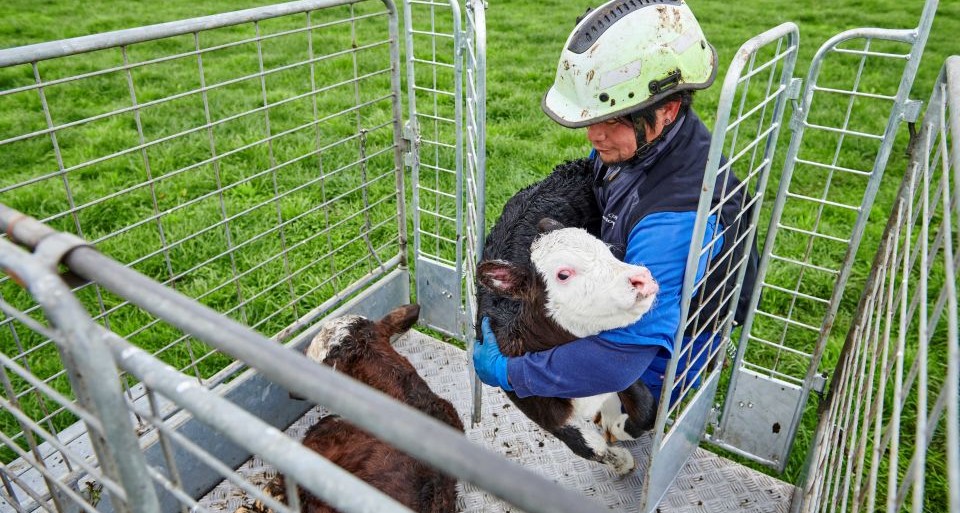
Of the various devices the group came up with, three have so far gone to market commercially. The easy-entry calf trailer gate minimises the struggle of opening and closing the trailer gate while handling a slippery, wriggling calf. It is now on sale from Kea Trailers.
The easy-access calf pen gate is a saloon-door design which addresses risks while lifting calves, teaching them to drink, and lifting buckets of milk and feed. It’s now available through Gallagher.
The easy-lift bucket trolley is a pivoting trolley which provides an easier and more efficient way to transport heavy buckets of milk or colostrum from the dairy to the calf-rearing shed. Buckets can slide onto the milk trolley platform without lifting and remain upright when moved, preventing spills. This has proven to be a cost-effective option for smaller farms and is now marketed by WheelCo.
A portable mat for use in fitting cups to cows while milking, which addresses long standing times and the different heights of milkers, has been developed but has yet to find a commercial partner.
These products are simple and relatively inexpensive, but all are designed to save dairy farmers time and to make their work easier – as well as having the side benefit of reducing the risk of injury.
Asking unexpected questions
Eastwood enthuses about the value of having people with a wide variety of backgrounds and expertise involved in the co-design process. He cites the involvement of ergonomist Brionny Hooper from Scion as an example.
“She was awesome. She didn’t know much about dairy farming but she knew a lot about the sort of processes that are behind injury. Just having people like that in the room – they ask questions you might not even think about.”
An example? At calving time the cows calve in the paddock and the farm team will go and fetch the calf back into the shed to feed it. It might be dark and wet and the calf might be wriggling and slimy and on uneven ground – a recipe for musculoskeletal harm.
“Brionny asked why do they even calve in the paddock? Why do you have to go out and pick them up? That got us thinking.”
Going beyond ideation
He’s particularly proud that the co-design work progressed well beyond the ideation phase and into designing and building prototypes that could be tested by farmers – in the field as it were – and then modified according to their feedback.
“In our projects we often stop after the first couple of phases. We don’t often get to prototype and test and iterate.”
The calf trailer gate came out of the first co-design workshop. Kia Trailers were keen to be involved and built a prototype, which was taken to half a dozen farms at the next calving season. “They said this thing doesn’t work so well and here’s how you could tweak it. We made the next version and tested it again. I think the one being sold now is probably the third or fourth iteration of the design.”
Similarly, during the discovery phase of the project a farmer had mentioned how he’d broken his leg while trying to move calves between pens. In the third workshop this insight led directly to the calf pen gate.
“The idea of having just one workshop to solve it? You need to be committed to a longer process if possible.”
A confidence boost
An independent evaluation of the project has predicted the prototypes developed and now in the market would reduce sprain and strain injuries in the dairy sector by 120 each year and would significantly reduce the number of days off work where injuries continue to occur.
Eastwood, whose remit as a DairyNZ scientist is to find ways to boost workplace productivity, is pleased with these outcomes. He is also pleased at the boost the project has given his team, because running multiple co-design workshops isn’t cheap.
“It’s given us the confidence that people will stick with you if the challenging is interesting enough.”
Now they are working on a project involving dairy farmers and their use of artificial intelligence tools. It sounds plenty interesting.