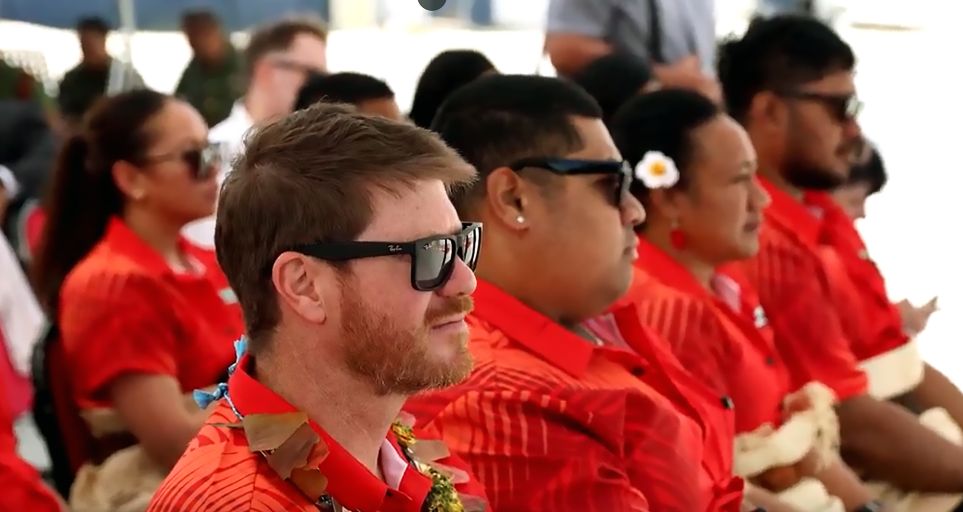
Anthony Vea smiles when he sees McConnell Dowell’s high-viz vests appearing on construction sites across Tonga. He reckons it’s visual testament to how the company’s project to upgrade the Queen Sālote International Wharf has influenced health and safety standards in Tonga’s construction industry.
A senior site engineer on the project, Vea says the project has empowered the local workforce with skills they can take with them into other jobs – along with understanding a health & safety culture and spreading it further.
“I see McConnell Dowell vests at a lot of other construction sites now. They’re still keeping their PPE standards high, and if you can get that right you can get other things right as well.”
It’s a pride shared by Brendon Barnett, McConnell Dowell’s HSEQ manager for the Queen Sālote Wharf project, who says he’d like the project to be remembered for helping others in Tonga lift their standards, improving the work environment and practices for all contractors.
The company’s work on the project saw it awarded a Judges’ Commendation at this year’s Awards.
Critical artery
The Queen Sālote International Wharf is a critical artery for Tonga, handling around 98% of the country’s imports. Its two wharves, however, were in dire need of renewal – one had been condemned five years prior to McConnell Dowell’s planning work commencing in June 2022.
The project, which was completed in October 2025, involved an extensive upgrade of both wharves, including full renewal of one and the installation of additional marine dolphins to accommodate larger vessels.
Utilities have been modernised, with electrical cables moved underline, a new electrical substation constructed and critical safety infrastructure installed, including a new firefighting system running off seawater and improved drainage to prevent ponding.
Around 36,000m2 of new pavement was laid with clear line markings to provide better structure and safety for container storage and movement within the operational port, which had to remain functional throughout construction.
Fundamental challenge
During tender preparation, McConnell Dowell identified a fundamental challenge: Tonga lacked formal health and safety legislation and structured competency requirements, and local workers, who would make up 80% of the workforce – around 180 at project peak – had little exposure to structured risk management or formal safety training.
“We had to build a safety culture from scratch,” Barnett notes.
The project also contended with risks of working at height and over water, extreme weather conditions – cyclones, heat, tsunami threat – and limited local medical services.
While that presented a clear challenge, it was also an opportunity to introduce New Zealand health and safety standards, upskill the local workforce and embed a culture of best practice.
Vea says getting the local team onboard with PPE was an early win. “They were like, ‘Uniforms! We get uniforms!’, so getting buy-in for PPE was pretty easy.”
Not so easy was getting them onboard for hazard identification and risk assessment. It was, Vea says, probably the hardest part at the beginning of the job.
“They have certain practices they do that they don’t consider unsafe – grinding without a mask or safety shields for example. That was stuff we had to work through. It was just a matter of them not knowing.”
The project saw significant upskilling to build a safety-first culture. More than 130 local workers were trained to New Zealand safety and job-specific standards, and workers were mentored on-site by experienced safety professionals to embed practical risk management skills.
Supervisors from around the Pacific were brought in to lead on higher risk activities, while throughout the project trainers were brought in from New Zealand to run training on topics like working from heights, confined spaces, slinging, dogging and rigging.
Worker participation
A cornerstone was fostering worker participation and building a genuine safety culture. Toolbox talks were delivered in Tongan – a language which Vea says is a describing language where there is no word for ‘hazard’, for example. Training materials were translated into Tongan and adapted to local customs, helping increase understanding and long-term impact.
Local safety champions and representatives were recruited, including eight local graduate engineers who joined project teams and contributed to daily safety planning, ensuring safety wasn’t a top down mandate but a shared responsibility.
Integrated risk assessments saw all workers given a See-Say-Do handbook to identify and report hazards, which could be submitted anonymously and in Tongan. Average monthly reports exceeded 300, well above the target of 200, highlighting active safety engagement.
“We’d have some good weeks where everyone had a hazard to report and we’d have a 30 minute discussion going through everyone’s See-Say-Do because they were just all so good,” says Vea. “Moments like that are where you see the safety culture change.”
Internalising the mindset
Barnett recounts the story of a local engineering assistant who noted a broken carabiner on a harness used on scaffolding which had been wired together.
“The engineering assistant stopped the work, took the harness off them and went and got them a proper, intact, harness,” he says. “Had he not gone through the training, he would never have known to pick that up.”
It’s a mark of the culture change, he says, to have workers internalising the safety mindset, rather than just following rules. “He could have chosen to look the other way, walk past and just think ‘that’s funny’. But he didn’t.”
While McConnell Dowell’s crew were outfitted in safety gear, using appropriate equipment and embracing a safety culture, Barnett recalls looking over the fence at another construction site on the port and seeing workers there doing a roofing job in jandals and shorts in the rain, with no protection.
“We never had much of that ‘why do we have to wear or do this?’-type discussions. I think they felt proud to have a uniform to wear and to work for an employer who was genuinely interested in their safety and making sure they didn’t hurt themselves.”
McConnell Dowell also implemented its own shuttle service to ensure workers could get to and from work and help deal with issues of fatigue from working longer hours than many were used to.
Delivering concrete skills
It wasn’t just those at the port site itself who were upskilling. McConnell Dowell established a concrete batching facility and testing labs on the island to ensure it had control over the concrete used in the project.
Equipment was flown in from New Zealand, and the operation was set up with local staff running it along with an expat supervisor for the batching plant and one for the lab. Engineers from the local polytechnic were trained to work in the lab.
“That’s another skill set that didn’t really exist in Tonga,” Barnett says. “I see it as a major win to be able to train a lot of those fundamental skills and give them hands-on experience and learning in a construction environment to make exceptional, marine grade, concrete.”
By working closely with local subcontractors, industry standards were raised. One key example was the local aggregate supplier, whose staff adopted PPE after engagement with the project team.
Lifting the standard
The project boasts over a million hours LTI-free, but for Barnett, it’s the indirect benefits in lifting standards that he’s most proud of.
“It’s the quarry supplier lifting their standard to be able to align with us and work on our site, and neighbouring contractors seeing what we’re doing and improving the work environment and practices for their people – that’s what I’d most like this project to be remembered for on a H&S front.
“I have so much optimism for other projects in Tonga, given the skilled crew we have built over the last three years.”